
Note: This post is a more permanent version of a LinkedIn post from September 2025.
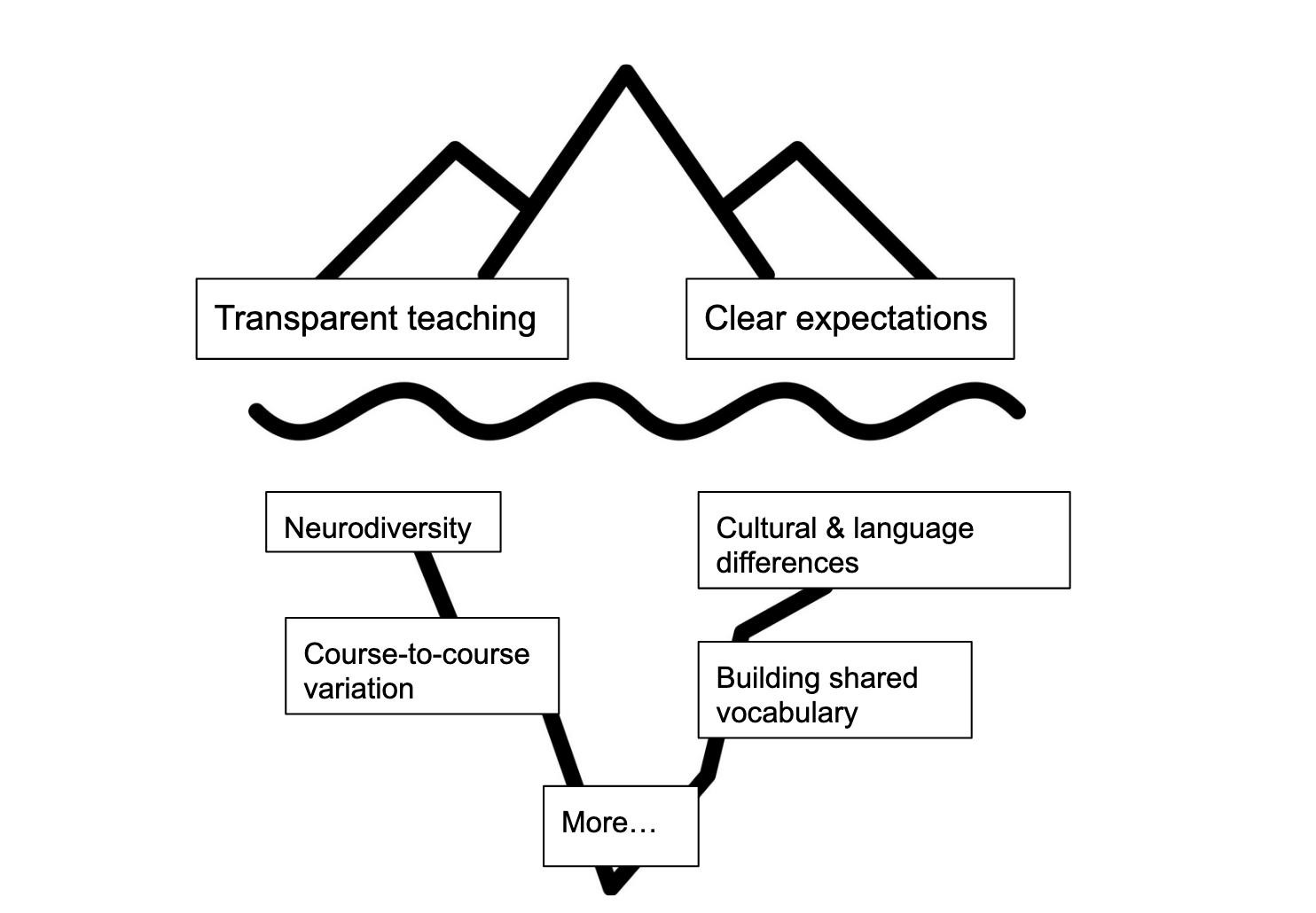
The idea of transparency in teaching has gained a lot of deserved recognition, especially through the widespread engagement with the TILT framework. I am starting to feel like “transparent teaching” or “clear expectations” is more of an “iceberg concept” – I think of it as something that is an excellent goal but more complicated than it initially seems.
I originally had this observation while thinking about the tension between neurodiversity and “transparency” or “clarity” – I think it is absolutely true that greater transparency and clarity will support neurodivergent students and facilitate communication in neurodiverse learning situations, but I think it naturally follows from the concept of neurodiversity that something may be perfectly clear to one person and not to another (for reasons involving neurodivergence or any of the factors depicted on this diagram). I continue to think of transparency and clarity as things that are earned by learning and understanding more about students. I think it always helps to ask to whom might this be clear and transparent and to whom it might not be.
An example I think a lot about is how my students will sometimes submit assignments according to the policies of other instructors at the same institution (e.g. certain formatting, citation style) which is not an unreasonable mistake to make because the institutions maintains a certain level of standardization across classes.
Image description: An iceberg diagram: Above the water line is “transparent teaching” and “clear expectations.” Below the water line is “Neurodiversity,” “cultural and language differences,” “Course-to-course variation,” “Building shared vocabulary” and “more…”
 Sarah E. Silverman
Leave a comment