
Note: This post is a more permanent version of a LinkedIn post I made in July 2024.
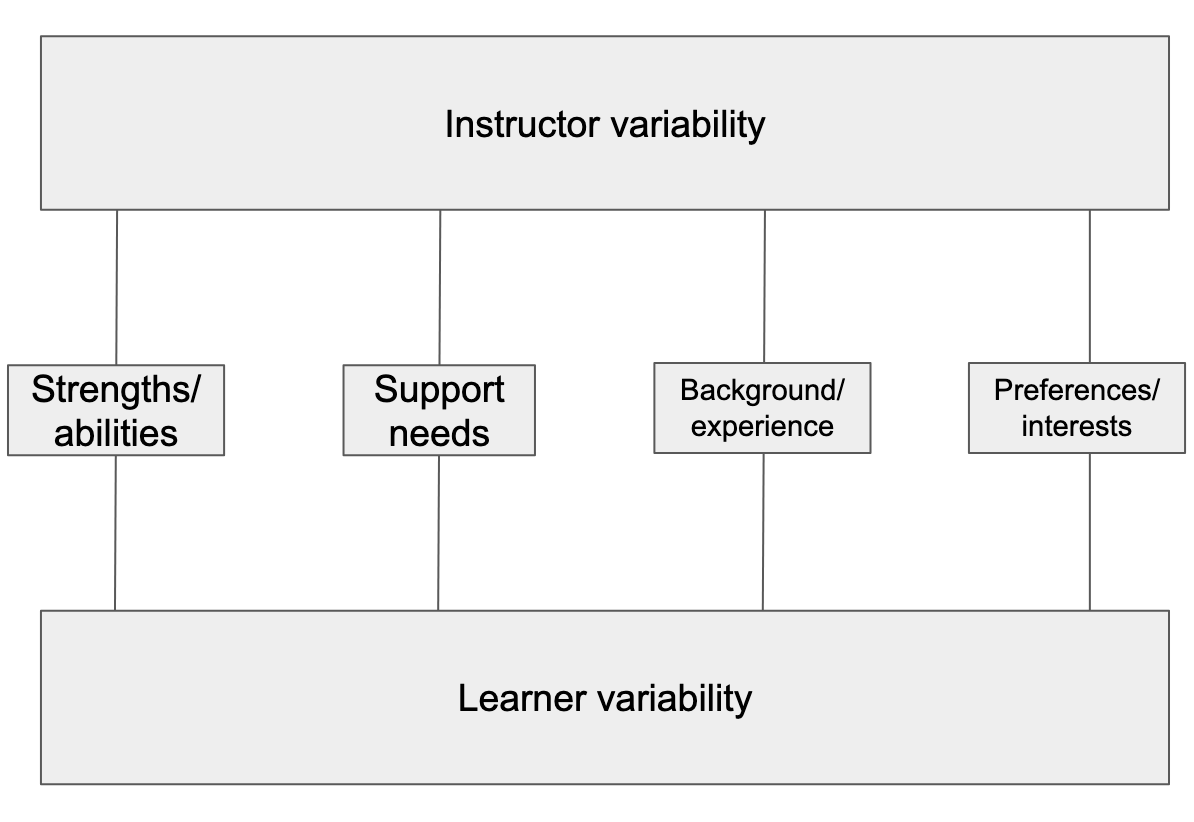
There has been some chatter about the limitations of “student-centered” teaching, I think most recently on a Tea for Teaching podcast episode with Sarah Rose Cavanagh. I have thought about this topic a lot, and one way I like to think about it is through the UDL concept of learner variability and how that may extend to instructors as well. I use this diagram to show that instructors have their own support needs as well, in ways that may mirror those of students.
This diagram is adapted from one in Kavita Rao’s 2021 article “Inclusive Instructional Design: Applying UDL to Online Learning” expanding on the UDL concept of learner variability, where she introduces these four elements of learner variability. I think these elements are a great framework for considering variability in all members of the learning community, including instructors. I try to think about ways we can see instructor and student variability and needs as part of the same project, not in competition.
Image description: A diagram showing similarities between instructor variability and learner variability. Two rectangles labeled “instructor variability” and “learner variability” area positioned at the top and bottom of the diagram, respectively. 4 lines labeled with text in rectangles connect the top and bottom rectangles. The lines are labeled, from left to right “Strengths/abilities”, “Support needs”, “Background/experience”, and “preferences/interests”.
References:
Rao, K. (2021). Inclusive Instructional Design: Applying UDL to Online Learning. The Journal of Applied Instructional Design: January 2021, 10(1). https://doi.org/10.59668/223.3753
 Sarah E. Silverman
Leave a comment